

FAQ
The FAQ page compiles frequently asked questions regarding product details, technical support and after-sales service, providing clear, authoritative answers for your easy reference.
Contact
-
Q:What post-sales technical support and field services does Mikrouna provide? +A: We provide comprehensive, end-to-end technical support throughout the operational lifecycle of your equipment:
● Installation & Commissioning: On-site dispatch of senior field engineers for installation, system integration, and rigorous operational training for local operators.
● Yield Ramp-Up Validation: On-site process engineers assist during trial production runs to ensure production lines rapidly reach target operational efficiency (OEE) and first-pass yield.
● Global Response & Upgrades: 24/7 technical hotline, rapid spare parts deployment, regular preventative maintenance checkups, and lifetime software and technical upgrade support. -
Q:What is Mikrouna’s typical equipment lead time, and how do you guarantee on-time delivery? +A: Delivery lead times vary based on system complexity and customization levels (stand-alone equipment typically requires a few weeks, while pilot lines and full turnkey lines depend on project scope).
Because 100% of precision machining, sheet metal fabrication, welding, and assembly are performed completely in-house, Mikrouna is free from third-party outsourcing bottlenecks. This total internal control empowers agile scheduling and eliminates supplier delays, guaranteeing dependable, on-time project delivery. -
Q:What environmental control and processing equipment does Mikrouna offer for solid-state battery production? +A: Solid-state and lithium-metal batteries require extremely low moisture levels and controlled atmospheres during processing. Mikrouna provides comprehensive ecosystem solutions:
● Ultra-Low Dew Point Systems: Industrial dry rooms and glove box systems maintaining ultra-low dew points down to ≤-70°Cdp, featuring advanced hermetic sealing structures and achieving 50%–60% energy savings compared to traditional environmental control equipment.
● Full-Chain Solid-State Equipment: Turnkey equipment covering cathode/anode preparation, solid electrolyte membrane fabrication, high-pressure densification, pressure-maintained formation, and precision cell assembly. -
Q:Can Mikrouna accommodate customized or non-standard equipment requirements for specialized battery chemistries? +A: Absolutely. Backed by an in-house R&D team of over 270 experienced engineers, Mikrouna excels in custom engineering. Whether you require specialized cell dimensions, custom electrochemical formulations, or unique plant footprint constraints, we design highly flexible, modular, and upgradeable automated manufacturing systems tailored precisely to your production goals (R&D, pilot line, or gigawatt-scale).
-
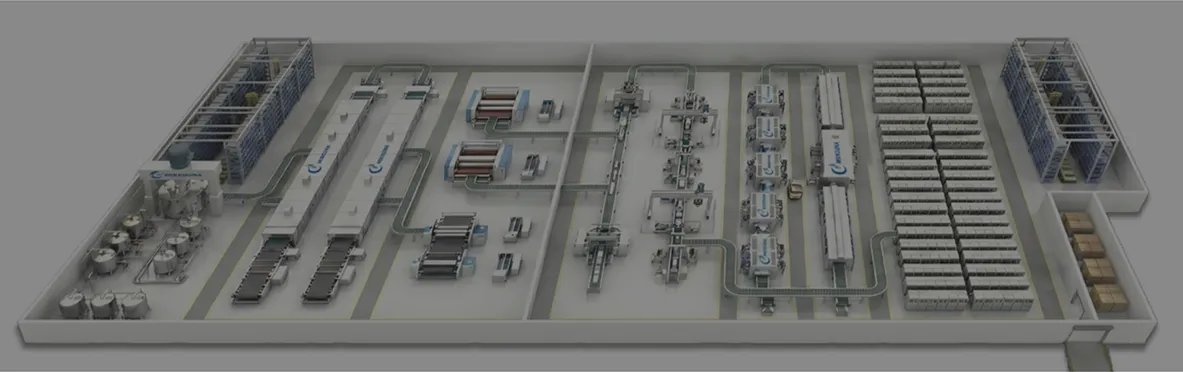
Q:What types of battery production lines can Mikrouna provide as Turnkey solutions? +A: We deliver full-lifecycle, one-stop turnkey solutions spanning initial engineering design, equipment manufacturing, on-site installation, commissioning, and process verification across four core production line categories:
● Pouch Cell Production Lines: Supports speeds of 10–20 ppm (semi-automated) and 20–30 ppm (fully automated), achieving an overall line utilization rate of 95.0% and first-pass yield ≥95.0%. Accommodates cell thickness 3–13 mm, width 40–100 mm, and height 50–200 mm.
● Prismatic Cell Production Lines: Fully automated lines operating at 6–24 ppm, stably producing mainstream 100Ah, 280Ah, and 314Ah specifications for EV power batteries and large-scale energy storage systems (ESS).
● Cylindrical Cell Production Lines: High-speed automated solutions reaching 20–120 ppm, covering standard 18650 and 21700 cell specifications for consumer electronics and power tools.
● Solid-State / Semi-Solid-State Lines: Customized experimental and pilot production lines engineered for next-generation battery cell chemistries and ultra-safe battery architectures. -
Q:What are Mikrouna’s core competitive advantages in the battery intelligent equipment sector? +A: Founded in 1998, Mikrouna is a National Level Specialized, Refined, Distinctive, and Innovative "Little Giant" Enterprise with over 20 years of industry expertise and more than 200 proprietary technology patents. Our core advantages include:
● 100% In-House Manufacturing: All production stages—including high-precision machining, sheet metal fabrication, welding, powder coating, assembly, and commissioning—are completed entirely within Mikrouna's own facilities with zero outsourcing. This guarantees total quality control and reliable delivery schedules.
● German VDA Standards Compliance: Our manufacturing operations strictly comply with German VDA standards, and process quality management is fully implemented in accordance with VDA 6.3 process auditing standards.
● Pioneering Technology Leadership: Industry-leading expertise in ultra-low dew point environmental control (≤-70°Cdp) and advanced solid-state battery pilot production solutions.


8613600040923

Mikrouna,Far beyond an equipment supplier — your long-term strategic partner for battery technology upgrading!